
 Jems
Jems
On Thursday, 29 January 2026, an expert workshop with stakeholders of the ROBONETCBC project was held at the University of Zadar. The workshop brought together around 40 stakeholders from all target groups, non-governmental organizations (NGOs), business support organizations (BSOs), and other organizations involved in environmental protection and natural resource management.
The aim of the workshop was to exchange knowledge and conduct an expert discussion on the scientific results of a comprehensive analysis of marine and freshwater ecosystems carried out within the ROBONETCBC project, as well as to involve stakeholders in the further development of innovative technological solutions for improving environmental monitoring systems.
Following participant registration, the project partners were introduced, and introductory presentations were delivered by prof. Ante Šiljeg, PhD, from the University of Zadar (Department of Geography / Center for Geospatial Technologies), Nuša Cukrov, PhD, from the Ruđer Bošković Institute, and Danijela Lovrić from the Chamber of Economy of Federation of Bosnia and Herzegovina.
The ROBONETCBC project and its strategic objectives were presented by the project manager, prof. Ante Šiljeg, PhD, who emphasized the importance of applying blue technologies, robotics, sensor systems, and geospatial technologies in the monitoring and conservation of marine and freshwater ecosystems. Particular emphasis was placed on moving away from traditional, logistically demanding monitoring methods toward the introduction of automated, highly precise, and data-integrated monitoring systems that enable more efficient, reliable, and long-term sustainable ecosystem monitoring.
In this context, the development of an innovative solution entitled “Integrated UAS for in situ sampling and water quality monitoring” was presented. This advanced system integrates an unmanned aerial vehicle equipped with an RTK positioning system, a multiparameter probe, an electric winch with a camera and altimeter, a communication module, a 3D-printed waterproof housing, and customized software applications.
The innovativeness of the system is reflected in the autonomous and extremely precise positioning of the measuring probe exactly on the targeted pixel of satellite or orthophoto data, addressing one of the key challenges of modern monitoring—the spatial mismatch between field measurements and data collected through remote sensing. The collected data are synchronized with RTK coordinates and linked with multispectral orthophoto models of very high spatial resolution, based on which machine learning algorithms are applied to generate continuous spatial maps of water quality.
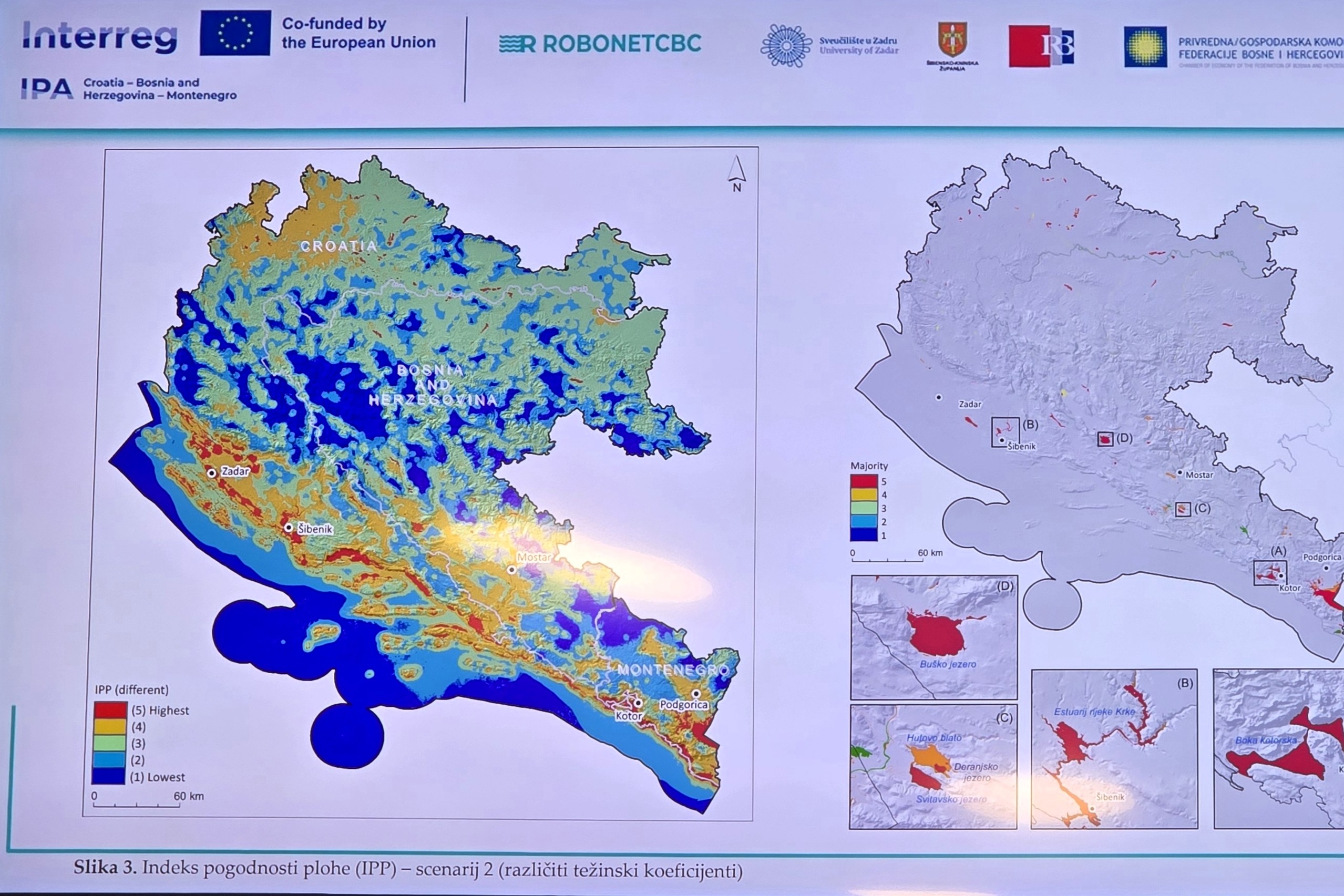
The central part of the workshop was dedicated to the presentation of the results of Activity 1.1, delivered by Assistant Professor Ivan Marić, PhD, from the University of Zadar. The presentation introduced the development of a methodological framework for the spatial, multi-criteria assessment of the condition of marine and freshwater ecosystems at the level of the Interreg VI-A IPA Croatia – Bosnia and Herzegovina – Montenegro programme area.
The main objective of this activity was to identify marine and freshwater ecosystems with the highest potential for the implementation of innovative multisensor technologies, that is, to narrow down the selection of research sites to one location that is scientifically most relevant and operationally most feasible for long-term monitoring.
The developed methodology is based on a multi-criteria GIS analysis (GIS-MCDA) that includes a review of the scientific and regulatory framework, definition of criteria and groups of criteria, data collection and harmonization, development and standardization of raster models, calculation of weighting coefficients, and their aggregation into the Potential Site Index (PSI). The PSI enables objective ranking of ecosystems according to their potential for the application of advanced monitoring technologies.
The model is based on three key groups of criteria: accessibility of the site for research, potential ecosystem vulnerability, and integration with the existing data network. This approach enables a realistic and sustainable selection of locations that simultaneously have high scientific value, priority importance for environmental protection, logistical feasibility, and ensured capacity for long-term monitoring and data validation.
The presented results served as the basis for a roundtable discussion entitled “Discussion on the Results of the Comprehensive Analysis of Marine and Freshwater Ecosystems in Three Countries,” moderated by Neven Cukrov, PhD, from the Ruđer Bošković Institute. During the discussion, participants exchanged views, experiences, and recommendations related to the application of the methodology, the selection of the pilot location, and the further development and implementation of innovative multisensor systems.
The workshop confirmed the importance of an integrated approach that connects scientific methodology, innovative technologies, and stakeholder needs, as well as the significance of the ROBONETCBC project in strengthening cross-border cooperation and developing modern, sustainable solutions for the monitoring and protection of marine and freshwater ecosystems.